
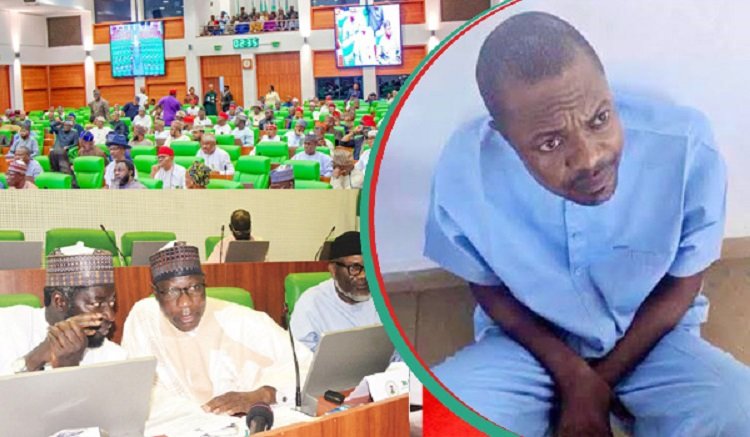
A House of Representatives investigative panel has uncovered how the fake Presidential Foreign Investment Promotion Council (PFIPC) secured a budget allocation in the 2026 Appropriation Act through forged documents and manipulated administrative processes.
Chairman of the committee, Yusuf Gagdi, said investigations revealed that the purported office of the Director of Administration and Support Services in the State House, which allegedly initiated the process, does not exist.
The panel heard that the self-styled Director-General of the fake agency, Prince Adeniyi Adeyemi Mathew, personally collected a letter containing the council’s administrative code from the Office of the Accountant-General of the Federation, even though it was addressed to the Permanent Secretary of the State House.
A former Director of Consolidated Accounts in the Accountant-General’s Office, Joshua Luka, told lawmakers that his office had deliberately addressed the letter to the Permanent Secretary as a safeguard, believing any fraudulent request would be detected there.
However, the letter never reached the State House, with an official confirming that Adeyemi collected it directly from the Accountant-General’s Office.
Gagdi alleged that Adeyemi later used forged documents acknowledging receipt of the administrative code to mislead the Budget Office into processing a budget allocation for the fake agency.
The Head of the Civil Service of the Federation, Didi Walson-Jack, admitted that her office approved an authorised establishment and recruitment waiver based on documents that later turned out to be forged, including a fake Act of the National Assembly and a fraudulent appointment letter.
She acknowledged that stronger due diligence should have been carried out and pledged to strengthen verification procedures to prevent similar incidents.
Meanwhile, the Nigeria Police Force told the committee it could not produce Adeyemi because he remains in lawful custody under a subsisting court order, adding that a court-issued production warrant would be required.
The committee has now ended its public hearings and will conclude the investigation through closed-door sessions before presenting its findings to the House of Representatives after the legislative recess.