
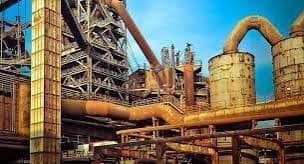
The Federal Government spent about N7.21bn on Ajaokuta Steel Company Limited between 2020 and 2025, even as the nearly 50-year-old Kogi-based complex remained largely dormant. The expenditure covered 501 transactions, including taxes, statutory obligations, pension and housing-fund contributions, maintenance, road works and other infrastructure-related payments, according to GovSpend records reviewed by The PUNCH.
The spending occurred while Nigeria continued to depend heavily on imported steel. National Bureau of Statistics data showed that the country’s iron and steel imports averaged about N526bn annually over the past six years. The figures represent officially recorded trade and exclude potentially unrecorded or under-reported imports.
Conceived in 1979 and developed with Soviet backing, Ajaokuta was designed as a major pillar of Nigeria’s industrialisation programme. The complex was built with the capacity to produce up to five million tonnes of steel annually, with the aim of using domestic iron-ore reserves to reduce import dependence and support industrial development.
Despite its limited production capacity, spending linked to the company remained substantial throughout the period. Expenditure rose from N795.4m across 57 transactions in 2020 to N1.19bn in 2021, before reaching N1.01bn in 2022. It increased further to N1.36bn in 2023, peaked at N1.66bn in 2024 and fell to about N1.20bn in 2025, indicating a recurring financial burden rather than a one-off intervention.
Some of the payments were routine obligations, including taxes, value-added tax, pension contributions and National Housing Fund contributions. Others covered maintenance and infrastructure work, including road rehabilitation, access-road repairs and solar street-light installations. Records also showed payments for infrastructure projects in Lagos, including areas around Obalende, Okofaji, Olowogbowo and Isale Eko, as well as rehabilitation of a 250-metre access road on Idoluwo Street, Lagos Island.
The spending comes amid renewed efforts to revive Ajaokuta and attract private investment. The Ajaokuta Presidential Project and Implementation Team, inaugurated in May 2020, was tasked with coordinating the revival programme and developing options for concession or partnerships with private and international investors. In July 2026, Ajaokuta Steel Company reportedly signed a 20-year gas supply agreement with the Nigerian National Petroleum Company Limited, providing three million standard cubic feet per day of firm gas and up to 47 million standard cubic feet per day of interruptible supply.
Ajaokuta Managing Director Nasir Naeem Abdulsalam, appointed in April 2025, said investors had consistently identified gas availability as a major concern, stressing that the plant could not operate without it. Limited production is currently taking place through a modular blast furnace producing manhole covers, utility poles and rail-track components for a small domestic market. The limited output contrasts with the government’s target of 10 million tonnes of annual crude-steel production by 2030, while the Minister of Steel Development, Abubakar Audu, has estimated that Nigeria spends about $4bn, or roughly N5.6tn, annually on iron and steel imports.