
As the Babajide Sanwo-Olu administration enters its twilight, the race for Alausa demands more than traditional political brinkmanship. With a complex megacity economy at a critical inflection point, the 2027 transition requires an anchor of institutional memory and technocratic precision.
Lagos is not just a state; it is a macroeconomic paradox. Operating with a GDP that dwarfs that of several sovereign African nations combined, Nigeria’s commercial nerve centre is simultaneously an engine of relentless innovation and a cauldron of infrastructural anxiety. As April 2026 ticks away and the Babajide Sanwo-Olu administration begins its inevitable descent into the twilight of its second term, the political machinery of the state is quietly revving up for 2027. Yet, the impending transition poses a distinct governance question: In a city buckling under the weight of exponential demographic growth, climate vulnerabilities, and complex mega-projects, can Lagos afford to hand its steering wheel to a political neophyte?
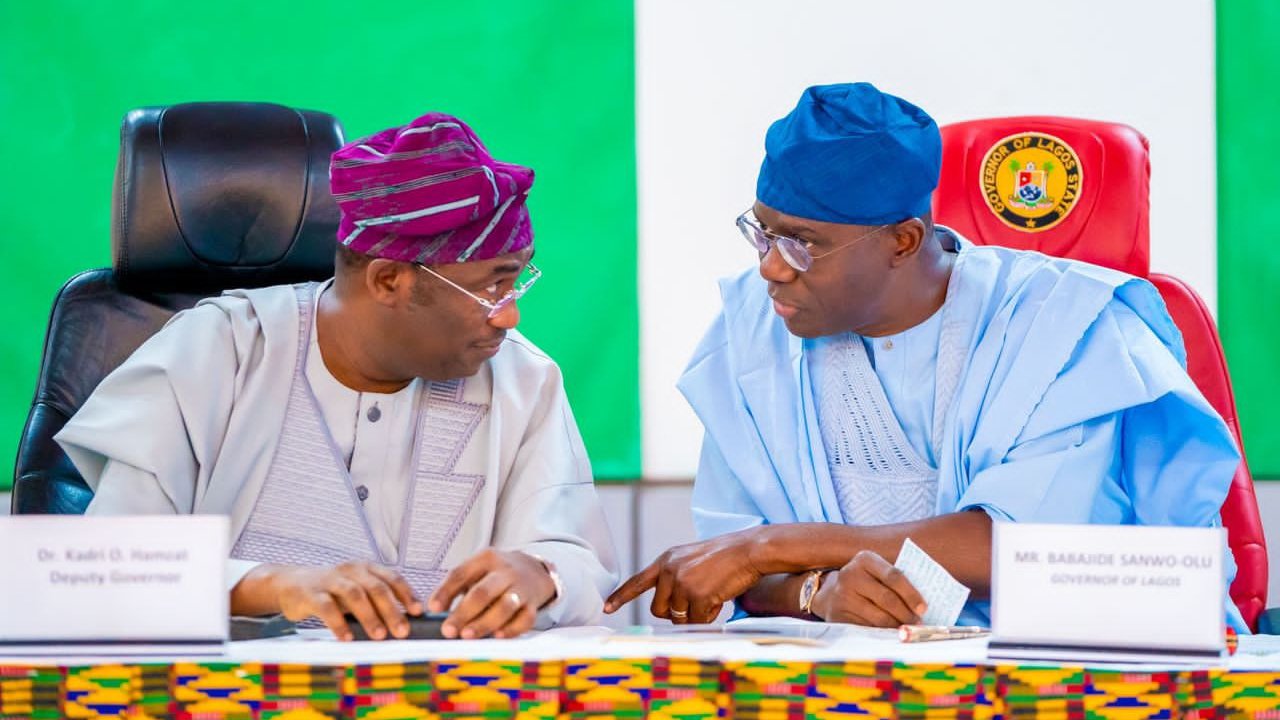
The consensus among policy analysts and governance watchdogs is a resounding negative. The next governor of Lagos will inherit a state that has outgrown traditional trial-and-error politics. The Red and Blue rail lines require meticulous operational scaling; the proposed Lekki-Epe international airport demands rigorous financial engineering; and the state’s digital economy is hungry for sophisticated integration. It is within this high-stakes context that the candidacy of Dr. Kadri Obafemi Hamzat, the current Deputy Governor, transitions from a matter of political ambition to an argument for structural necessity.
To understand Dr. Hamzat’s positioning is to look beyond the ceremonial confines often associated with the office of a deputy governor in Nigeria. His trajectory is a study in technocratic immersion. Armed with a B.Sc. in Agricultural Engineering from the University of Ibadan, an M.Sc. in Crop Processing Engineering, and a Ph.D. in System Process Engineering from Cranfield University, Hamzat’s foundational DNA is wired for systems, processes, and optimisation.
Before his foray into the turbulent waters of Lagos politics, his professional life was anchored in the corporate sector, notably with stints in the United Kingdom and as an IT consultant for global giants like Morgan Stanley. When he was brought into the Lagos State cabinet in 2005 as Commissioner for Science and Technology during the Bola Ahmed Tinubu administration, he was not drafted as a political heavy-hitter, but as a technical problem-solver. He was tasked with dragging the state’s archaic, paper-heavy civil service into the digital age.
Across successive administrations, Hamzat has cultivated a reputation for quiet efficiency, anchoring foundational reforms that often go unnoticed by the public eye but remain central to the state’s operations. As Commissioner for Science and Technology, he championed the implementation of the State’s Oracle Enterprise Resource Planning (ERP) system. This was not merely an IT upgrade; it was a systemic overhaul that blocked financial leakages, optimised revenue collection, and fundamentally altered how the Lagos civil service functioned. It was under his watch that Lagos deployed the electronic document management system and the biometric data capture for civil servants, a move that famously purged the state’s payroll of thousands of ghost workers.
His transition to the Ministry of Works and Infrastructure under Governor Babatunde Fashola further solidified his reputation as an executioner of complex mandates. During a period widely regarded as the golden era of Lagos infrastructure, Hamzat was the engine room, supervising the construction of critical arterial roads, bridges, and state-wide public works.
Since 2019, as Deputy Governor to Sanwo-Olu, he has sidestepped the historical curse of redundant deputies. The Sanwo-Olu-Hamzat ticket has operated more as a co-piloted administration. From chairing state executive council meetings in the governor’s absence to directly overseeing critical components of the THEMES agenda, Hamzat has remained deeply embedded in the state’s daily governance matrix. He knows where the files are, he knows the financial structuring of the state’s debts, and he understands the technical specifications of ongoing mega-projects.
Lagos politics operates on a delicate balance of populism, elite consensus, and technocratic delivery. The ruling All Progressives Congress (APC) in Lagos, led by President Bola Ahmed Tinubu, has historically favoured a succession model that prioritises competence layered with party loyalty. From Fashola to Ambode to Sanwo-Olu, the template has largely been to install a technocrat-politician capable of managing the state’s intricate economy while respecting the political establishment.
However, the 2027 election arrives at a precarious moment. The 2023 general elections delivered a sharp shock to the Lagos political establishment, with the opposition Labour Party taking an unprecedented slice of the electorate. This shifting demographic, younger, more impatient, and largely detached from traditional political loyalties, demands visible governance outcomes over political rhetoric.
In this climate, the APC cannot afford to field a lightweight or a strictly transactional politician. The party needs a candidate whose competence is indisputable and whose governance record can withstand hostile scrutiny. Hamzat fits this profile precisely because he represents continuity without the baggage of administrative disruption.
Dr. Hamzat’s greatest strategic advantage is preparedness. In governance, the learning curve is often paid for in wasted taxpayer funds and stalled projects. If elected, Hamzat would require zero onboarding. He would not need a 100-day transition committee to brief him on the state’s urban planning deficits or the intricacies of the Lagos State Security Trust Fund.
This deep institutional memory allows him to be framed as the ultimate continuity candidate with the capacity for immediate reform. He possesses the unique ability to seamlessly carry on the legacy projects of the Sanwo-Olu administration while possessing the intellectual rigor to identify and correct existing administrative bottlenecks. Furthermore, his unblemished public record, free from the corruption scandals that frequently derail political careers in Nigeria, gives him a significant advantage in appealing to the middle-class and corporate demographics of Lagos.
Yet, politics is not fought solely in boardrooms or policy documents; it is waged on the streets. If Hamzat has a political vulnerability, it is the perception of his political persona. He is widely viewed as a patrician intellectual, a policy wonk more comfortable dissecting architectural blueprints and budgetary frameworks than engaging in the performative populism often required to court the grassroots electorate.
In a state where “street credibility” and the ability to speak the language of the informal sector are highly prized currency, Hamzat’s reserved, highly analytical nature can be misconstrued as aloofness. The challenge for his political machinery will be humanising the technocrat. He must now lead from the front and articulate a vision that resonates emotionally with the common man, without losing his core identity as a disciplined administrator. Furthermore, he will need to navigate the complex intra-party dynamics of the APC, ensuring that his intellectual independence does not alienate the political base.
Looking toward the 2027–2031 electoral cycle, Lagos faces a daunting set of futuristic challenges. The state’s population continues to swell, putting immense pressure on housing, sanitation, and mobility. Climate change threatens its coastal geography, demanding urgent, science-backed environmental policies. Meanwhile, the city is racing to position itself as the undisputed tech capital of Africa.
These are not challenges that can be solved by political patronage; they are complex engineering and socio-economic problems. A Hamzat governorship would likely prioritise data-driven governance, strict adherence to urban planning master plans, and aggressive digital integration. His background suggests an administration that would heavily favour public-private partnerships to bridge infrastructure deficits, operating with the efficiency of a corporate entity rather than a traditional bureaucracy.
For the international investment community and the local private sector, his elevation to the top seat would signal stability. It would provide the assurance that the regulatory and economic environment in Lagos would remain predictable, governed by a mind that understands the mechanics of global finance and system optimisation.
As the countdown to 2027 accelerates, the political theatre in Lagos will undoubtedly feature a parade of aspirants, each armed with rhetoric and ambition. But the governorship of Africa’s fifth-largest economy is not an entry-level position. It is a role that requires a brutal understanding of the state’s plumbing, both literal and metaphorical. Dr. Kadri Obafemi Hamzat may not possess the loudest voice in the boisterous political arena, but his quiet, sustained impact on the governance architecture of Lagos speaks volumes. In an era where the margin for error is razor-thin, Lagos does not need a leader to learn on the job; it needs a honcho who has been doing the job all along.
Kelechi Oluwadare Halilu writes from Lagos, Nigeria