

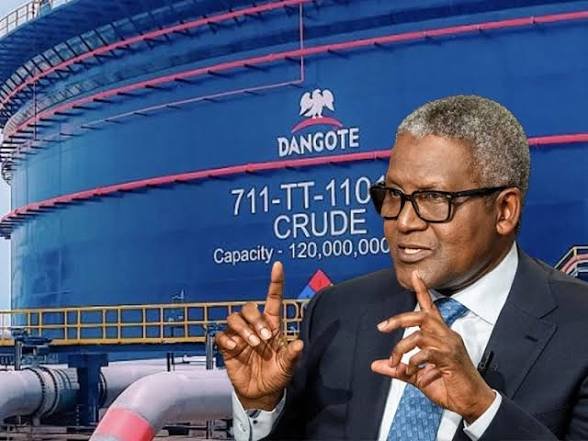
Dangote Industries Limited has commenced preliminary work on its proposed $17 billion, 700,000-barrels-per-day refinery in Kenya, marking the first major step towards establishing what is expected to become East Africa’s largest refining facility.
The company said the project has moved beyond the planning stage, with the project site already selected on Lamu Island, while soil tests, engineering and design work are currently underway ahead of construction.
According to Reuters, the refinery is expected to be completed within three years and will supply refined petroleum products to Kenya and neighbouring East African countries, reducing the region’s dependence on imported fuel.
Bloomberg also reported that President of the Dangote Group, Aliko Dangote, personally assured the Presidents of Kenya and Uganda that he would build a refinery in East Africa similar to the company’s refinery in Lagos. Kenyan President William Ruto had earlier announced that construction would commence this year.
Dangote Industries’ Vice President for Oil and Gas, Devakumar Edwin, confirmed that Kenya had always been the preferred location for the project, adding that the refinery would be financed through internally generated funds, bonds and proceeds from the company’s planned Initial Public Offering (IPO).
Although the company did not disclose the final cost of the project, it said the investment would be comparable to the Lagos refinery, which eventually cost more than $20 billion before commencing operations in 2024.
The Kenyan refinery represents Dangote Group’s first major refining investment outside Nigeria and forms part of its wider expansion strategy across Africa.
The company also revealed plans to increase its combined refining capacity to 2.1 million barrels per day by adding the Kenyan refinery to the ongoing expansion of the Lagos refinery, whose capacity is expected to double from 700,000 barrels per day to 1.4 million barrels per day by 2028.
Dangote Industries further disclosed plans to invest an additional $46 billion between 2026 and 2028 across its refining, cement and fertiliser businesses as it seeks to accelerate industrialisation across the continent.
The company said the Kenyan project reflects Africa’s growing drive to strengthen local refining capacity, improve energy security, reduce dependence on imported petroleum products and boost regional trade in refined fuels.