

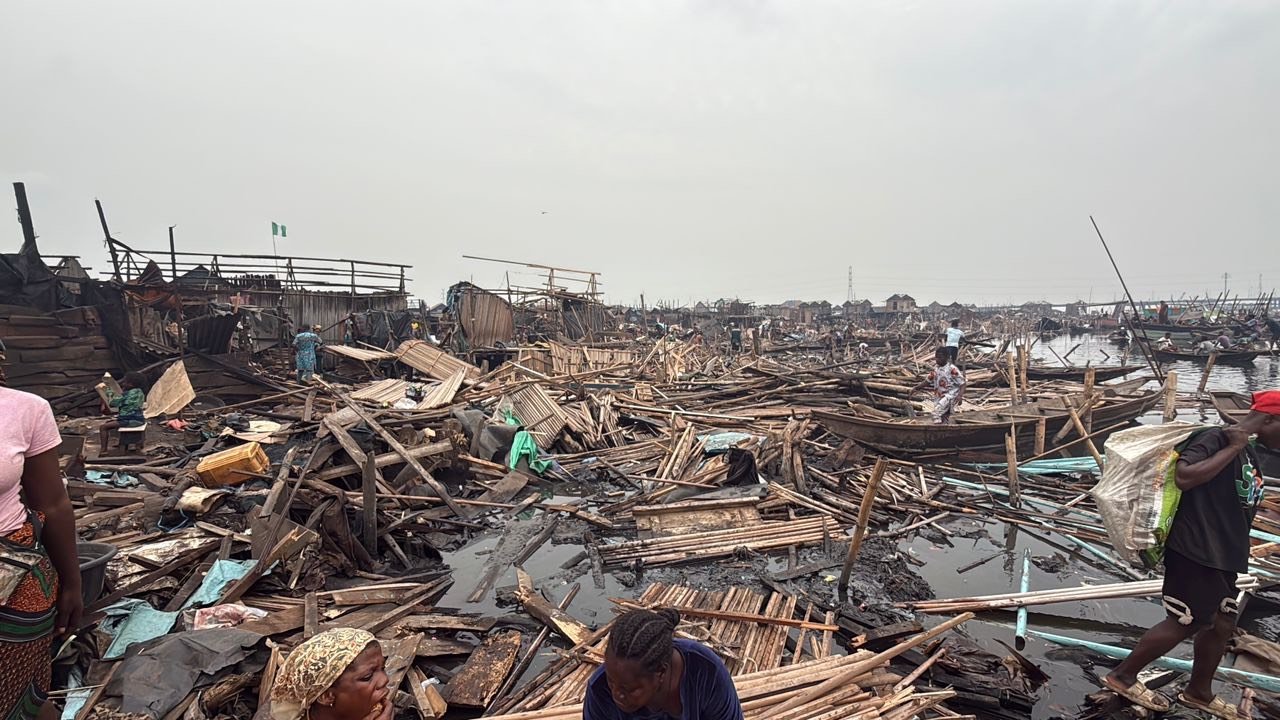
An urban development expert has called for a more inclusive housing strategy in Lagos, warning that recent demolitions in Makoko reflect deeper structural challenges in the city’s urban planning.
Folasope Pinheiro, an architect with London-based firm Greig and Stephenson, said Lagos’ rapidly growing population is far outpacing available housing, forcing many residents into informal settlements such as Makoko.
According to him, the city gains about 2,000 residents daily, while fewer than 10,000 housing units have been built in the past six years, leaving a large number of new residents without formal housing options.
Pinheiro described Makoko, often referred to as the “Venice of Africa,” as a historic fishing community that dates back to the late 19th and early 20th centuries when Egun settlers established homes along the lagoon.
He explained that the settlement gradually expanded over the decades, with many houses now built on wooden stilts over the water as population density increased.
The architect noted that while Makoko faces significant challenges, including poor sanitation and environmental concerns, the community has also developed strong social networks and a self-sustaining artisanal fishing economy.
However, tensions rose following demolition operations in parts of the settlement in December 2025, during which thousands of homes were reportedly destroyed and thousands of residents displaced.
Pinheiro warned that redevelopment strategies focused solely on large infrastructure projects could disrupt existing communities if residents are not included in the planning process.
He advocated an “enabler” approach in which the government supports community-led development by providing infrastructure, financing and technical assistance while allowing residents to guide redevelopment efforts.