
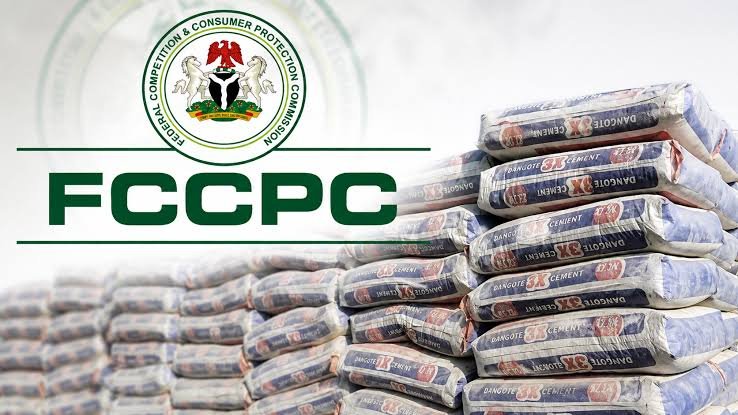
The Federal Competition and Consumer Protection Commission has launched an investigation into possible price manipulation in Nigeria’s cement market after the price of a 50kg bag rose to between N13,000 and N15,000 in some parts of the country by July 2026.
The probe followed a three-month cross-border study by the FCCPC’s Anti-competitive Practices Department, conducted in response to widespread complaints about rising cement prices. The commission has summoned major producers to provide records on their pricing methods, production levels, capacity utilisation, exports and commercial relationships.
Three companies, Dangote Cement, HMB Nigeria and BUA Cement, account for more than 90 per cent of Nigeria’s cement production. The FCCPC said the investigation was prompted by concerns that domestic prices remained unusually high despite Nigeria’s substantial limestone deposits, significant production capacity and reported surplus capacity.
The commission estimates Nigeria has installed cement production capacity of more than 60–65 million metric tonnes annually, compared with domestic consumption of about 25–30 million tonnes. Nigeria is also a net exporter of cement to neighbouring countries, raising questions about why excess production capacity has not translated into lower domestic prices.
A cross-border comparison showed a 50kg bag of cement selling for about N7,344 in Kenya, N6,528 in Tanzania and N9,180 in Togo, compared with up to N15,000 in Nigeria. The FCCPC noted that Kenya, Tanzania and Togo have smaller populations, while Togo does not have domestic limestone deposits, unlike Nigeria.
The commission said cement prices rose from N9,300–N9,700 in January to N10,500–N13,000 by mid-2026 before reaching N13,000–N15,000 in some areas by July. Industry participants attributed the increases to energy costs, naira depreciation, higher costs of imported machinery and spare parts, transportation and logistics.
FCCPC CEO Tunji Bello said the investigation would not dictate how businesses set their prices or prevent legitimate profits. Instead, the commission will determine whether current prices are justified by verified costs and market conditions or whether there is evidence of coordinated pricing, abuse of market power, restrictions on domestic supply or other anti-competitive practices.